
Authored
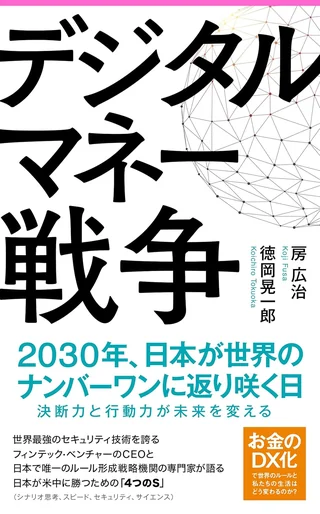
The Digital Money Wars
デジタルマネー戦争
Koji Fusa · Koichiro Tokuoka
English edition with Nicholas Edwards
Forest Publishing, 2021
Cyber security and ratings will shape trust in banks
GVE's Provisioned Trust Infrastructure (PTI) is built for that future, in finance and beyond.
GVE develops infrastructure to protect the customer data that financial institutions hold and strengthen security across domestic and international financial systems.
GVE is committed to transforming the global financial system through AI-resistant and quantum-resistant infrastructure. Our Copernican approach redefines the operating model of money for central banks, sovereign wealth funds, family offices and international financial institutions — providing secure, efficient services for both domestic and cross-border settlement.
A domestic payment at a contactless terminal is designed to settle within 0.2 seconds. Securities and cash settle together in one all-or-nothing step, delivery versus payment.
Aiming to make electronic health records across national hospital networks readable within seconds, over a quantum-secure route.
Biometric authentication on one personal device carries the holder across national ID, banking and public services — and takes the friction out of impersonation and phishing defences.
Once the device and its holder are matched on a phone or PC, trust between them rests on keys GVE provisions, not on a big tech identity service or a certificate authority. With PTI, each country and each bank gains greater control over its own operations.
GVE designed PTI to check the authority for each transaction before execution and to protect transaction paths with symmetric cryptography where keys have been provisioned in advance.
Each device receives a key in advance through in-person issuance with approval from two registrars. Each request is protected and verified with a key derived for that request alone. The per-request key is never sent over the network.
Per-Request KeysIn a fully mediated PTI domain, every protected operation passes through a functioning control it cannot bypass. The control checks the authority for that transaction before execution, including for protected operations requested by AI agents.
Transaction-Specific AuthorityIn a harvest now, decrypt later (HNDL) attack, an attacker records encrypted traffic today and tries to decrypt it later. On a provisioned PTI transaction path, the parties already have a shared key relationship and use AES-256 without relying on public-key exchanges vulnerable to quantum attacks.
Provisioned Transaction PathCritical cryptographic keys are generated, held and erased inside a hardware security module (HSM), isolated from the rest of the system.
Sensitive operations need more than one person: a key issued by one registrar goes live only when a second registrar approves it, so no single person can act alone.
GVE's architecture follows ISO/IEC 24643, the international standard specifying an architecture for a distributed real-time access system. GVE's founders took part in drafting it. The standard is technology-neutral; the security properties are GVE's design within it.
GVE plans to obtain Japan's IoT security certification along with the other major certifications worldwide, and ultimately to accelerate deployment into critical national infrastructure through independent audit against the Common Criteria.
Finance is where GVE starts. The invention behind PTI ties a defined authority to each shared key, and it is not limited to one algorithm or one industry, so the same foundation can apply wherever access has to be authorised.
Government-issued digital ID and electronic certificates.
Electronic health records across hospital networks.
Authentication between IoT devices, for smart cities and infrastructure monitoring.
Traceability across supply chains and logistics.
Permissions among the participants in a distributed ledger.
Authority set for each agent and checked on each transaction, inside a fully mediated PTI domain.
Within this market, GVE focuses on settlement infrastructure. GVE combines its foundational patents and technology with a public-private partnership model for working with banks, financial institutions and governments.
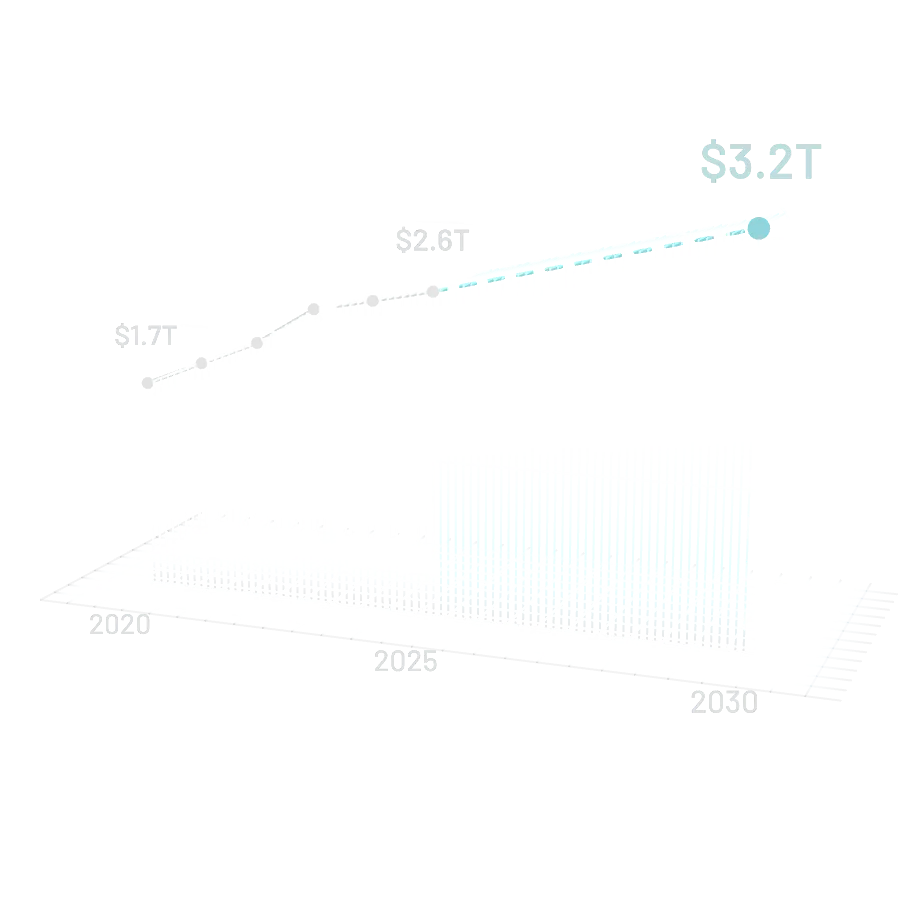
Source: McKinsey, The 2026 Global Payments Report
GVE's financial OS includes a Central Bank Digital Currency platform and serves as real-time gross settlement (RTGS) infrastructure for any legal tender. Central bank-issued currency is only about 3% of M2 — the remaining 97% is GVE's first target for secure digitisation.
A vaccine-passport system for verifying immunisation records at airports. In 2024 the WHO Digital Clearing House selected it for its catalogue of digital health solutions.
GVE holds broad foundational patents across three areas essential to digitising global finance. Its key-authority patents span two PCT families. The term for PCT family 3 runs to December 2040 and the term for PCT family 4 runs to September 2041. Actual protection depends on the granted claims, jurisdiction and maintenance.
PCT Family 4 term: Sep 2041
A combination extraordinarily rare across global fintech, CBDC, same-day settlement in capital markets, and real-time cross-border payment.
Created one of the earliest smart/contactless card systems — NFC. Tap to pay now makes up about 80% of Visa's face-to-face transactions outside the US (Visa, July 2024).
Built the foundation of the world's first mobile payment system — predating Apple Pay and Google Pay by nearly a decade.
Involved in drafting ISO/IEC 24643 — the international standard specifying an architecture for a distributed real-time access system. GVE’s resistance to AI and quantum attack is its own design within that architecture.
Patented the key-authority technology behind PTI in Japan, since granted in the United States, Europe and other countries. Against unauthorised AI privilege escalation on bank servers, the three-dimensional 3-way-database defence is patented as well.
Former CEO of UBS Trust & Banking Japan, then the highest-rated private bank in Japan. Concurrently a director of DLJdirect SFG, Japan's second-largest online broker, from 2000 to 2003, and of Emcom, then the world's largest independent FX technology company, from 2005. Deep expertise in engagement with overseas central banks and governments, and in sovereign capital markets; highly regarded among European policymakers, financial academics and practitioners in standardisation. Concurrently special strategic adviser to paediatrics at the University of Oxford. Responsible for GVE's long-term strategy.
Involved in drafting and refining the ECMA-417 standard at Ecma International's TC51. Leads GVE's automation through AI assistants, and the strategy of getting the largest result from a small, senior team.
Leads GVE's technology development. Former Director and CTO of Raksul, lead engineer at DeNA, and built bond trading systems at Morgan Stanley. Director of the Japan CTO Association.
Former CEO of Rubicon, the Albanian fintech behind the Pago payments app. At GVE, responsible for project management on GVE OS and PTI, business development, and coordination with regulators and other stakeholders.
A security specialist, highly regarded outside Japan as the developer of NFC. Strategic adviser on security and originator of GVE's long-term technology vision. Inventor of the NFC (implemented 1997) and mobile payment (implemented 2004) technologies that underpin GVE OS.
Written and translated into English by GVE's founders — an account of GVE's long-term strategy: the transformation of money, the technology that started it, and an IP strategy that combines international standardisation with technology kept undisclosed, to enlarge the market GVE can serve and keep a lasting competitive advantage.

Two appearances on Nikkei CNBC's Morning Express in September 2026, in which anchor Atsushi Naoi puts GVE's business strategy to CEO Koji Fusa. Published with the permission of Nikkei CNBC, which holds the copyright.
 2026-09-11
Koji Fusa, the CEO of GVE — the company rewriting the financial operating system and aiming to set the global standard — joins as guest. A sharpening sense of security risk is a strong tailwind. The programme asks about the business strategy.
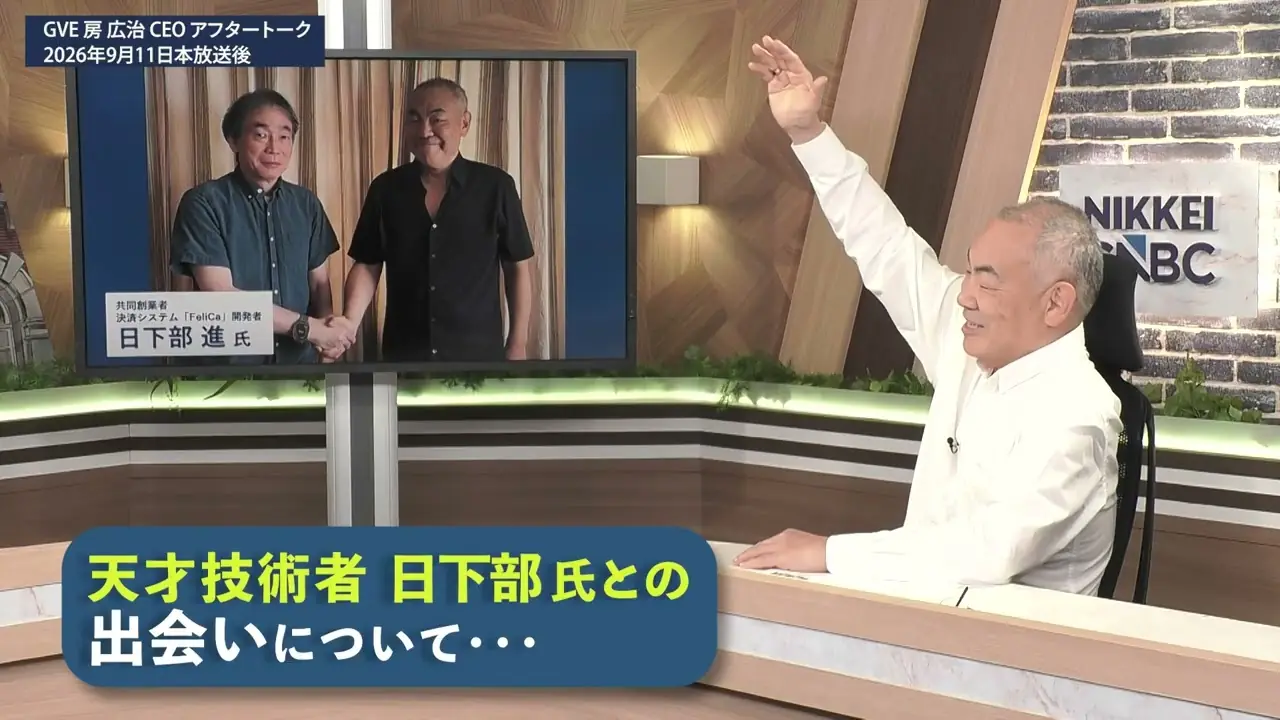 2026-09-15
The after-talk that followed the Morning Express interview of 11 September, broadcast on 15 September 2026.
| Trade Name | GVE Ltd. |
| Corporation No. | 0100-01-187660 |
| Established | 10 November 2017 |
| Chief Executive | Koji Fusa |
| Registered Office | Kabuto-cho Kaisei Building Annex 4F, 13-1 Nihonbashi Kabuto-cho, Chuo-ku, Tokyo 103-0026 |
| Capital | ¥100,000,000 (as of October 2025) |
| Website | gve.net |
In 2017, the co-founders of GVE rethought the financial system from first principles — improving security and operational efficiency at a structural level. The resulting system has been patented in Japan, the United States, the United Kingdom, France, Germany, Italy and other countries.
Global payments industry revenue is forecast to reach $3.2 trillion by 2030. Within that market, GVE focuses on settlement infrastructure through a public-private partnership model designed for working with governments in developing economies.
The history of money — from gold to paper to digital — is one of humanity's greatest ongoing inventions. We are engineering its next chapter.